The Scarlet E: Confronting the Life-Altering Consequences of an Eviction



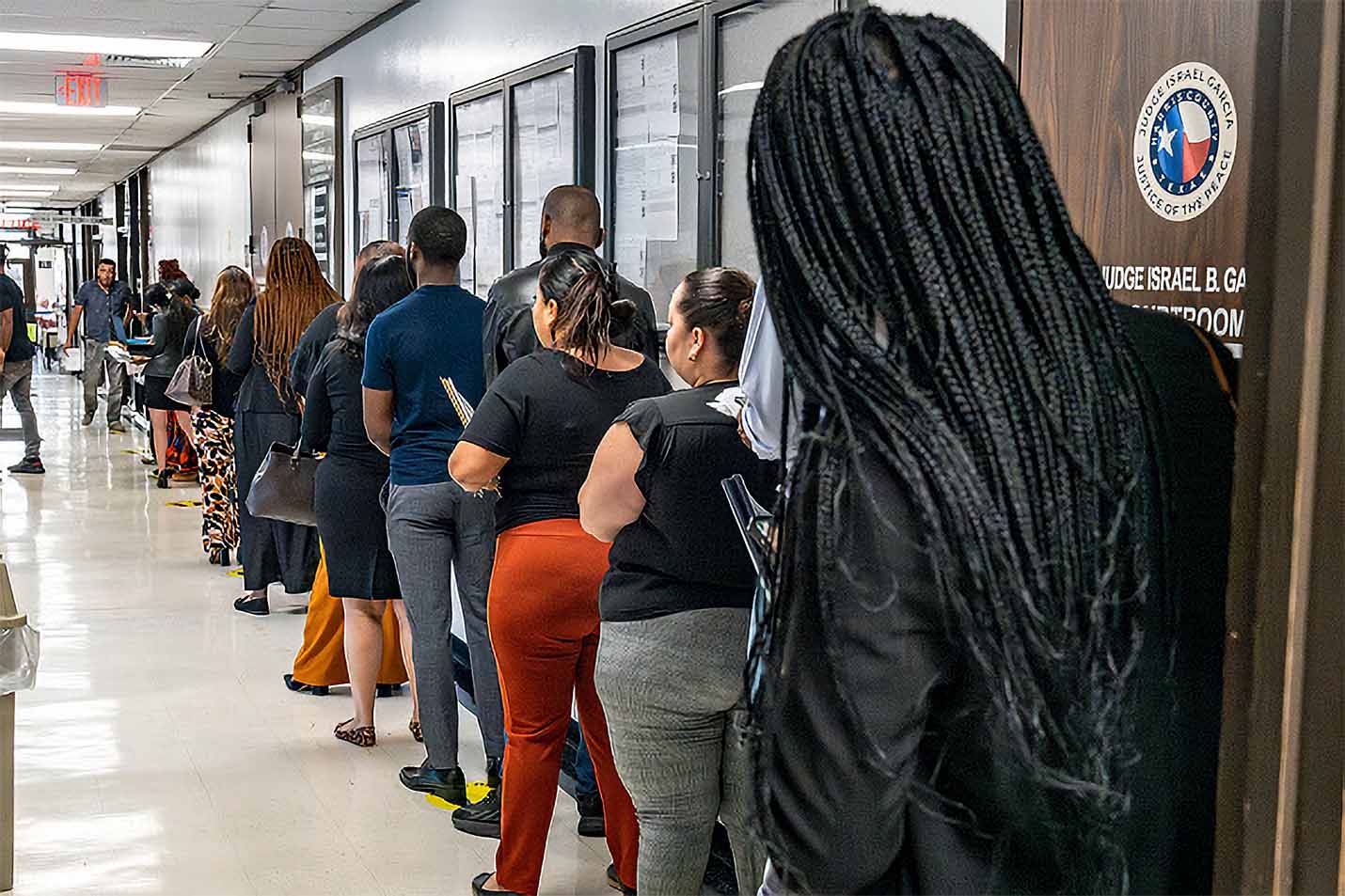 A line forms down the hallway outside Harris County Justice of the Peace court as persons involved with eviction cases wait to appear before a judge. (Kirk Sides/Houston Chronicle via Getty Images)
For renters in the United States, experiencing an eviction can shape long-term well-being—even when it’s a once-in-a-lifetime event. That eviction case forces renters into an immediate scramble to find a new place to live, while leaving a permanent scar on their rental history. Because there are few limits on who has access to court records or how long they remain available, the stain of a single eviction filing severely restricts future housing opportunities. The barrier to stability is so profound that researchers have given it a specific designation: the “Scarlet E.”
This Scarlet E is persistent and public, rippling through every aspect of a tenant’s life, from the loss of housing and employment opportunities to long-term physical and mental health effects for the entire family. At its core, the Scarlet E functions as a contemporary form of social and economic exile, institutionalized through automated tenant screening.
This was the case for the Dillard family, who were locked out of safe housing due to algorithmic carelessness. When Randy Dillard Jr. applied for his first New York City apartment a decade ago, every application was rejected. Confused and devastated, he called his father with a difficult question: “What did you do?”
Fifteen years before, Dillard Sr. rented a Bronx apartment with a Housing Choice Voucher. He remembers stocking up on buckets to catch rainwater pouring through the leaking ceiling, and plugging in his son’s nebulizer when the unit’s mold caused his lungs to seize shut. When the ceiling collapsed, the New York City Housing Authority halted rent payments. Instead of making repairs, the landlord filed for eviction.
That single filing landed Dillard Sr. on a corporate “do not rent” list. Landlords routinely rejected his applications, rendering his guaranteed housing voucher worthless.
“They only know that you were in court, and that’s the harm it does to you,” Dillard Sr. reflected. Because tenant screening companies frequently rely on automated name-matching without verifying case identities, Randy Jr. was automatically and mistakenly branded with the “Scarlet E” and locked out of the rental market alongside his dad. The system forced Randy Jr. to double up with relatives, who had a different last name that could shield him from the rental ban, while his father only secured a home after a New York City commissioner intervened to lobby landlords directly.
An article published in the Ohio State Law Journal takes a closer look at these dynamics, documenting the evidence linking eviction court records to negative health outcomes and disproportionate harm to Black renters. The article reviews current federal, state, and local strategies designed to restrict access to these court records. Currently, most jurisdictions nationwide still allow the tenant screening industry to scrape and aggregate decades of eviction data—even pulling case files that are subsequently sealed—on millions of households.
READ THE ARTICLE:
Dismantling the 'Scarlet E': Eviction Record Privacy as Health Justice
Emily A. Benfer
The American judicial system is founded on the principle of the public’s right to access court proceedings and records. This cornerstone idea is rooted in the belief that judges should always have responsibility to the public. But the public’s open access to the court is easily abused, especially when it comes to eviction filings.
With the advent of electronic court records, tenant screening companies—collectively valued at $3.77 billion and projected to grow to over $5 billion by 2030—started commodifying the public’s open access to court records by selling these data to landlords. Property owners use these automated reports to generate predictive risk assessments that reduce an applicant’s complex rental history to a determination of a “good” or “bad” tenant.
However, the reports that these companies produce are notoriously inaccurate and misleading. Screening companies include all interactions with the eviction system, even cases when the renter won or filed affirmatively against a landlord for legal violations. They also rely on partial name matches, so automated reports—that are typically imbued with bias—frequently capture “false positives” due to unverified rental history and criminal background, including data based on mistaken identity. Without mandatory steps to validate this information, such as checking the data against the applicant’s full date of birth or Social Security Number, the screening may attribute the eviction case to the wrong person, as it happened with the Dillards. Ultimately, a single algorithmic error can plunge a family into homelessness simply because an applicant shares a common last name with someone who faced a housing emergency three states away.
Despite their known errors, tenant screening reports are often the deciding factor in whether a landlord accepts an applicant. These automated judgments and subsequent rejections disadvantage low-income Black women with children, who already face eviction at disproportionate rates: Black Americans make up only 18.6% of renters but account for over half of all eviction filings. Compounding the crisis, landlords in many states can name every member of a household in an eviction filing. This means children and young adults can have a Scarlet E attached to their names for decades, starting before they are old enough to sign a lease.
The human body often pays the price. “It was a nightmare. To wake up, and go to bed, and not knowing where you gonna lay your head… going into a shelter, it’s like going into a prison,“ Dillard Sr. remembered. His children developed anxiety, and their grades plummeted from A’s to D’s. “It messes with you mentally,” he added, “it really does.”
Families branded with an eviction filing are forced to settle for substandard housing where they are more likely to be exposed to environmental hazards like chipping paint, mold, and pests, conditions that trigger asthma, lead poisoning, and chronic safety concerns. The physical and psychological toll of an eviction filing is staggering: research shows that an eviction filing is associated with a 19% increase in early mortality and individuals facing the loss of their home are more than twice as likely to experience depression and suffer from anxiety.
What can be done to ensure that tenant screening reports are accurate? In recent years, federal and state policymakers have attempted to limit landlord reliance on court records when screening applicants. At the federal level, the Fair Credit Reporting Act (FCRA) serves as the primary federal law requiring landlords to inform rental applicants when a rejection stems from a screening report. The FCRA relies on three key features:
The Federal Trade Commission (FTC) and the Consumer Financial Protection Bureau (CFPB) can enforce these laws and impose fines on screening companies that don’t comply. For example, the FTC penalized RealPage with a $3 million fine for using search criteria that included information on people with similar surnames, while a joint CFPB and FTC complaint against TransUnion Rental Screening Solutions secured a $15 million settlement and an agreement to reform their screening practices. The U.S. Department of Housing and Urban Development also issued formal guidance that is still in effect, clarifying that the Fair Housing Act applies directly to background checks and housing decisions that use AI and automated algorithms.
Yet, federal oversight stops short of addressing the root issue: scoring models and the algorithms underlying tenant screening reports. Because companies are not required to register with the federal government, any attempt at monitoring and enforcement is challenging. A few jurisdictions–including Colorado, Minnesota, New York, Washington, Minneapolis and St. Paul, MN, and Philadelphia, PA–have enacted bolder policies. These states and cities actively control how screening reports can be used, with some effectively prohibiting landlords from denying housing applications based on a previous eviction alone.
While these protections shield renters from inaccurate data reports or instances of mistaken identity, what about families who have faced actual eviction proceedings? In this situation, the law provides little recourse. Policymakers and courts in over twenty states and Washington, D.C., have adopted laws to block access to court records, attempting to prevent the Scarlet E through targeted record sealing or expungement laws. Yet, loopholes dilute their effectiveness. One solution would be to seal records from the start of the eviction case, a safeguard that only exists in California and Colorado. Across the rest of the country, tenant screening companies have ample time to mine, scrape, and permanently archive court data before it can ever be sealed.
State laws restricting record access are often limited to certain conditions. Most statutory protections are limited to cases where a minor is named in the eviction filing, instances where a specific duration of time has elapsed (typically seven years), cases triggered by a unique circumstance or hardship (such as foreclosures, the sale of property, or the COVID-19 pandemic), or outcomes where the tenant prevailed, a settlement was reached, or the case was dismissed. In Massachusetts and Illinois, for example, the record must be automatically expunged or sealed if the complaint names a minor. Other states require the tenant (or landlord) to petition the court for record sealing or expungement, or rely on the discretion of the judge or court, something that provides no guarantee that the record will be sealed. In addition to state statutes, various courts have established general rules and administrative orders dictating when and how judicial officers may seal records.
These current laws and policies, while critical, only partially mitigate the “Scarlet E” crisis due to a lack of monitoring and enforcement. True structural change requires comprehensive federal and state intervention. Federal lawmakers have repeatedly introduced tenant screening regulations and eviction sealing requirements, most notably through legislation like the Housing Emergencies Lifeline Program Act and Eviction Crisis Act. Coalitions like the Tenant Union Federation, National Housing Law Project, and National Low Income Housing Coalition collaborated to release the National Tenant Bill of Rights that includes protections in the rental application process.
States do not need to wait for federal legislation to protect their residents. State policymakers can proactively adopt automatic record-sealing statutes, while court systems can improve their existing procedural norms to ensure case files are inaccessible to non-parties from the exact moment of filing. At a minimum, jurisdictions should seal default judgments, consent judgments, dismissed filings, and cases where the tenant prevailed. For maximum protection, all evictions should be permanently sealed after a reasonable, narrow timeframe. The research shows that the earlier an eviction record is sealed, the greater the positive effect on housing stability.
Importantly, a privacy-first system can still include exceptions within eviction sealing laws to allow certain groups to access the data (similar to provisions in Washington, D.C. law), allowing verified researchers and monitoring organizations to access anonymized data to identify housing trends and promote housing stability. Protections that focus on preventing the use of data for corporate profit and restoring data privacy can ensure that our legal system no longer traps families in a lifetime of housing instability.
By moving toward mandatory sealing of filings and holding screening companies accountable, cities and states can begin to dismantle the Scarlet E and ensure that an eviction filing will never again lock a family out of a stable home.
 Filed under research